The video game industry is changing course Here you can read an article that I prepared for the course Periodísitica Production of UAB. A job that I enjoyed the cooperation of several people who, from here, I want to thank (and apologize for the brevity of some contributions, but had to be condensed.) As observed, the text is aimed at a broad audience. Hence certain specifications that in another context, would fully and understood.
The original article can read it on the following link:
wikidiario  Over two years have passed since the launch of the Wii console to market. During this period, Nintendo has drawn a new landscape in the industry video game that hits, inevitably, with the model that had prevailed until now.
 Place the disc in the drive, take command, he settles into his chair and in a moment the game begins. Lyrics to Call of Duty appear quickly on screen and announce an experience that put the player to a real test. A continuum of gunfire, grenades and forced him to demonstrate his ability to control the game. His fingers move at full speed and tension creeps into a room where there is only this: the game and player. At the other extreme, a whole family smiling in front of the TV. Now is the turn of the grandfather, who gets up, grabs the driver, with un suave movimiento de brazo, dibuja la trayectoria de una bola que impacta virtualmente contra los bolos tridimensionales de la pantalla.
Estas dos imágenes opuestas dicen mucho de la situación que vive el mercado del videojuego en la actualidad. Un sistema que ha experimentado cambios profundos en los últimos años debido, en gran parte, a la política de Nintendo. En el ocaso de la pasada generación de videoconsolas, la compañía de Kyoto se encontraba en una grave situación económica fruto del fracaso de Game Cube, y tuvo que dar un golpe de timón para no seguir los mismos pasos de Sega y abandonar la producción de consolas. Sin embargo, el lanzamiento de la portátil Ds en el año 2004 supuso the establishment of a database that would catapult the company to success. The potential of portable touch screen coupled with the emergence of the Touch Generations, a new range of games that advocated the intuitiveness and fun instant close to the public under proposals unusual, marked the way forward for Nintendo.
in 2005 offers three major video game companies, Sony, Microsoft and Nintendo, for the new generation of consoles and were more defined. While Microsoft and Sony consoles were betting on a more powerful and guarantees an online service for Xbox 360 and PlayStation 3 respectively, Nintendo pointed to a new direction. The project was initially known as Revolution, but eventually acquire the name Wii. The console was presented at the Tokyo Game Show that year and spawned debate about its proposal. Far from being able to compete technologically with Sony and Microsoft, Nintendo had invested their efforts on designing a machine whose main asset was a motion-sensitive control, without major changes to the graphics power on a Game Cube. It has been more than two years since then, and now it's time to ask what has really changed during this time.
market opens
Nintendo The primary intention in developing the Wii conceptually was that of bringing the game to everyone. "We want to attract players and not players," said the leader of the company, Satoru Iwata, at the launch of the console. A message has been played through some advertising campaigns, and from the very first time, showed the family nature of the games and the ability to involve everyone, lover or digital entertainment. "For practical purposes, has opened the consumer market at a rate of not consuming public before games, just as people over 50, children under 10 or women," says the former editor of the magazine Xtreme supergame and current director of the biannual Mondopixel, Peter Berry, popularly known in the industry as John Tones. According to the video game critic, this change has brought about new ways to play that conflict with the more traditional forms and has meant that, in general, the gaming experience more accessible, immediate and trivial as before.

As pointed Salvador Fernandez, associate Meristation, English-language magazine specializing in video games accessed on the network, "now there are two models of different console, the Wii made up and occupying Xbox 360 and Playstation 3. "
Success and controversial Since its release, the Nintendo Wii has sold nearly 50 million units worldwide, according to company officials. A figure that exceeds the results obtained by force of competition, which fall to Xbox 360 in second place with about 28 million machines sold and Sony's PlayStation 3 in third, with about 22. To these figures must be added the tremendous success of the portable Nintendo DS, which has more than 100 million and has become a full-fledged boom with titles to his credit as representative as Brain Training or Nintendogs,
However, loose despite the triumph of the sales company in Kyoto, have published numerous reviews by the specialized groups that question the actual quality of these products, especially the Wii home console, which is accused of not having a strong library of games and having left the regular player or hardcore gamer . "If someone believes that Nintendo cares about anything but making money is deceiving," said Marc Bellmunt, which carries a lifetime playing video games. In the words of player, Nintendo has found another audience more easily satisfied, so-called casual gamers, and this has meant a change of business for a company that has always struggled to give licenses to third parties. A view shared by the critical cultural Pablo Muñoz, contributor to the magazine Chimera has made some tests on video games. "The reality is more painful than it sounds, since the self-proclaimed hardcore gamers are not the public at large and it still has become more evident when the market has cuadripilicado" says Muñoz. For its part, Sergi Puig, habitual consumer of Nintendo products, believes that more games will come out hard for the hardcore gamer for the Wii, though, he says, expect mistakes.
limits revolution revolutionize gaming system. This was the message released by Nintendo since the features unveiled Wii techniques. But to what point the Wiimote, the controller of the machine, has brought a new playable beyond its commercial success? John Tones, the Wiimote is a disaster for one simple reason: "When you play a fighting game with a conventional control is carried out representation, for example, X = roundhouse kick. If you try to do that with the wiimote, the physical representation proposed the concept can not be carried out and, therefore, the game fails. " In a similar vein to pronounce Yuri Quero, a regular player, who believes that Nintendo tried to convince people that with their hands, players could carry out any action playing Wii. Proof that not, Quero opinion, is the fact that the company has had to pull aside the sale conventional controllers for certain games could be played.
"Anyone who has tried a Wii shooter will be unable to switch to a normal pad." J. Oriol Serracant, manager of a community on the web nintenderos believes that Wii is not a revolution, but their contributions are more than interesting for certain games. However, Serracant recognized that the lack of accuracy of the third company to adapt when you use the command is taking its toll.
Rather than marketing Elderly
training your mind, boys and girls practicing yoga or couples looking for the best recipe, in the Cooking Guide Ds game are small samples of the impact of advertising campaigns for Nintendo at the social level. Messages which are a model of collective game against the classic image of the lonely player and have emerged as a key part of the company's commercial success. "What has helped this operation much marketing is that people see the game as entertainment to be enjoyed in groups," says Ricard Campeny regular player. This perception coincides with Oscar Garcia, who is considered a sporadic player and claims to have the Wii just to play some multiplayer games when you have guests at home.

Finally, the cultural critic Pablo Muñoz seconded these views with the following statement: "Everything is summed up, fortunately or unfortunately, in the notice homeland where Amparo Baró and Javier Cámara happy to play Brain Training ". What they advertise, says Muñoz, not so much a console, but something sporty, fun and even healthy for the mind. In other words, the game becomes a "cool gadget, fun and family."
Paradigm Shift
Where is directed gaming industry in terms of market games and platforms? This is the question many are made from the arrival of Wii in the market and the emergence of a new target wider and plural. "There will be three new consoles and the three operated the basis that Nintendo has been used to break the market," said Salvador Fernández. Meristation collaborator that the fact that Sony and Microsoft do not compete verbally with Wii is just an excuse for not recognizing their failures against Nintendo. The video game critic John Tones you venture a little further and predicts that the paradigm shift will occur in all dimensions, in commercial terms, the objective is please the most from this new market of casual gamers at the design level, continue climbing towards the hyper-realism, and in industrial analysis, the big games will be bigger yet scarcer, while the smaller will be more abundant and many thanks to lower costs and accessibility of programming and distribution systems. "There will come a time when indie production is significant and stands up to mainstream production, as happens in the movies. And perhaps that is the time when we consider that the industry and the media are really mature, "says Tones.
is still early to talk and dynamic processes that form part of the future world of video games, but what nobody doubts is that this industry moves forward and moves at breakneck speed into new forms of exploitation of the environment. The journey, in this generation of technology, is experiencing a genuine turning point.


 La Feria del Libro de Buenos Aires, 2009 ended . It is perhaps one of the only events of the "Culture" more crowded and commercial success in an unprofitable sector. No lack of speeches, presentations, riots, figures and cameras as usual. Without doubt, television was the main character because, as a trend of recent years, publications are most talked about celebrities in the glow of the idiot box.
 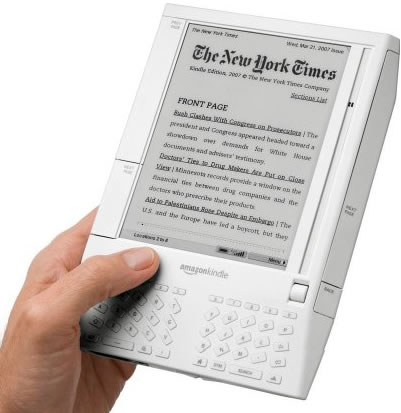 In the United States is already on sale on Kindle, such as an iPod of books, which wirelessly connects to Amazon.com and you can download thousands of titles, payment. Everything is in the air, it seems.


